
Rural Non-Farm Sector Livelihoods
Rural non-farm sector-based livelihoods encompass economic activities in rural areas beyond agriculture, forestry and fisheries, crucial for economic diversification, poverty reduction and rural development. By offering alternative income sources, livelihood opportunities, the non-farm sector improves living standards and reduces dependency on agriculture. The specific projects with RNFS component and their contribution to the RNF Sector are detailed below.
FRDP, SAFAL, HCDP, CCDP, MJMM, and BASUDHA
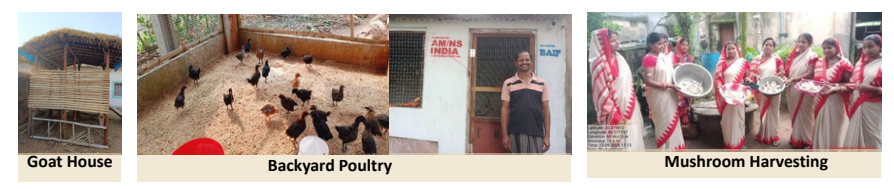
Major Achievements: Across various projects under the Rural Non-Farm Livelihoods (RNFL) component, the projects successfully expanded income generating opportunities beyond agriculture, reaching 576 households. Key interventions included mushroom cultivation, backyard poultry, low-cost goat housing, paper plate production, badi-making, nurseries, and flour mills. These activities, implemented through both individual and group-level models, significantly improved income resilience, especially among landless and marginal farmers. Backyard poultry emerged as a prominent livelihood option, with over 170 new poultry houses established this year across MJMM, CCDP, BASUDHA, and HCDP projects, supporting women and smallholder farmers with regular income and nutritional security. Mushroom farming was actively promoted under FRDP, SAFAL, and HCDP, with over 80 units supported and essential training and materials provided. Low-cost goat housing and the development of nurseries, equipment banks, and enterprise clusters further bolstered rural entrepreneurship. On an average, RNF participants earned ₹10,000–₹18,000 annually, with many women entrepreneurs stepping into independent income-generating roles.