


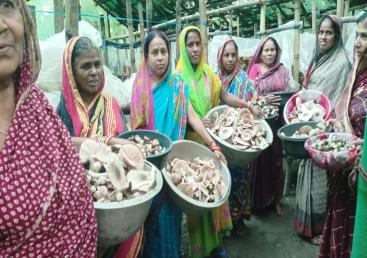
Empowering Women Through Mushroom Cultivation: A Case Story of the Nuagarh Women Farmer Group
Empowering Women Through Mushroom Cultivation
The Jagruti Producer Group from Nuagarh village under Nuagarh Gram Panchayat in Paradeep block, Jagatsinghpur district, Odisha, represents a remarkable example of women-led livelihood transformation. Traditionally engaged in household responsibilities, women in this village had limited exposure to income-generating activities. However, this changed on 5th September 2023, when 24 motivated women united to form a mushroom cultivation group, initiating small-scale mushroom farming to support their families.
Their endeavour gained new momentum in May 2024, when Project SAFAL, supported by AM/NS India and implemented by BAIF, extended structured training, technical guidance, and a dedicated mushroom cultivation shed. This support enabled the group to enhance their skills, adopt improved cultivation practices, and scale up their production.
Since then, the group has successfully produced approximately 3.5 quintals of paddy straw mushrooms and also cultivated oyster mushrooms based on local market demand. Through improved practices, they reduced the cost of preparing one mushroom bed from ?35 to ?30, helping optimise the overall production cost. Their total turnover has crossed ?1.3 lakh, with an estimated production cost of ?20,000 and reinvestment of around ?30,000 for expanding operations. Each member has earned ?2,500, while the remaining income has been retained in the Producer Group’s bank account to ensure financial stability and future growth.
Mushroom demand in and around Nuagarh is consistently high, with the group selling their entire daily produce within the village and neighbouring areas. The mushrooms fetch a price between ?300 and ?350 per kg, going up to ?380 per kg during the off-season. The increasing number of advance orders highlights the strong market acceptance and growing customer trust in their produce.
Beyond economic gains, this initiative has significantly boosted the confidence and social cohesion of the women. Working collectively has strengthened interpersonal relationships, encouraged shared decision-making, and created a supportive environment that promotes unity and leadership. The success of this group stands as a testament to how women-led enterprises can drive inclusive and sustainable development in rural communities.
Looking ahead, the group aims to expand production by establishing more mushroom sheds and adopting off-season cultivation techniques to ensure year-round income. They also plan to tap into urban markets such as Cuttack and Bhubaneswar to secure better prices and enhance profitability. With continued support and improved infrastructure, they aspire to evolve into a scalable rural enterprise that not only uplifts its members but also contributes to the broader economic development of their region.